

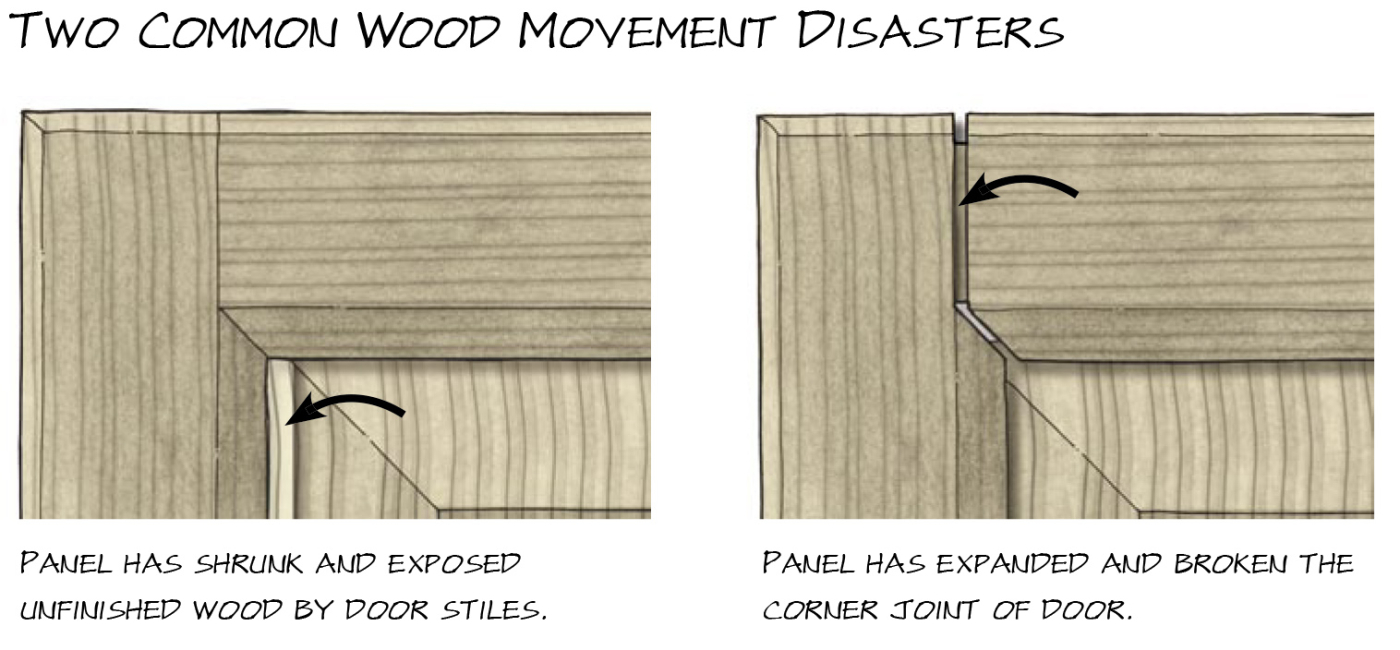
Wood movement represents one of the most significant challenges in woodworking, capable of damaging even the most meticulously crafted pieces. The good news is that anticipating and precisely calculating the shrinkage and expansion of wood is a straightforward process. It simply involves multiplying three key figures together. In this detailed guide, we will walk you through identifying and obtaining each of these essential numbers step by step, empowering you to design projects that withstand environmental changes over time.
Step 1: Accurately Measure the Board’s Width
Understanding the dimensions of your wood is the foundational step in this calculation process. It is crucial to recognize that boards with greater widths will experience more pronounced expansion and contraction compared to those that are narrower. This is because wood primarily moves across its width, rather than along its length or thickness. To proceed, carefully measure the width of your board in inches using a reliable tape measure or caliper for precision. This measurement serves as the primary dimension in the formula and directly influences the magnitude of potential movement.
Step 2: Determine the Average Annual Fluctuation in Moisture Content
Moisture levels in the air play a pivotal role in how wood behaves dimensionally. High humidity environments cause wood to absorb moisture and swell, while low humidity leads to drying out and subsequent shrinkage. To quantify this for your specific location, employ a moisture meter – an indispensable tool for any serious woodworker. Monitor and record the peak moisture content (MC) during the humid, wet season and the trough during the dry season. Calculate the annual variation by subtracting the lower MC value from the higher one. In most homes with climate control systems, such as heating and air conditioning, this yearly swing typically ranges from 3 percent to 4 percent. However, this can vary based on your regional climate, so personal measurement provides the most accurate data for reliable predictions.
Step 3: Identify the Dimensional Change Coefficient for Your Wood Species
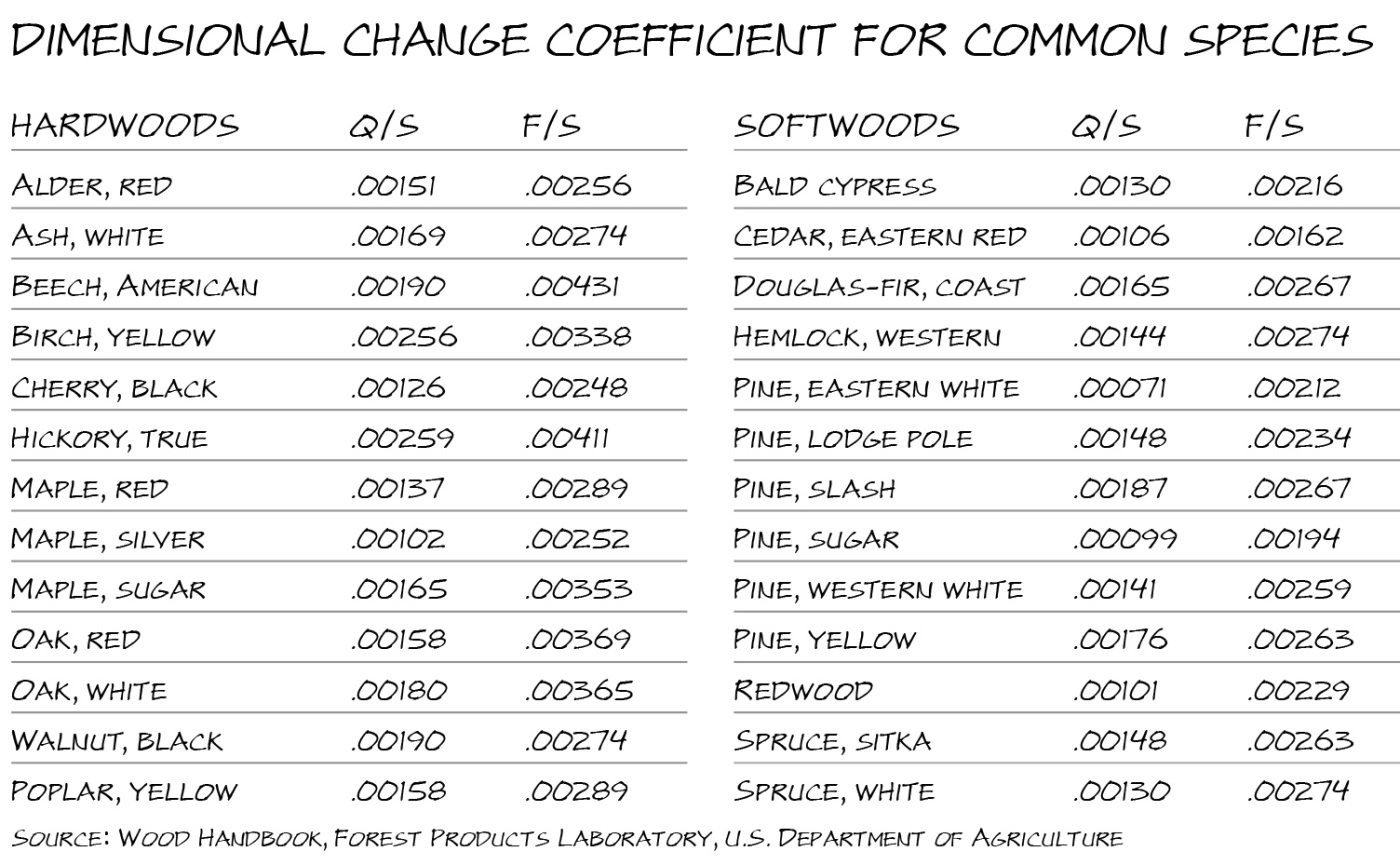
The dimensional change coefficient is a species-specific value that quantifies the tangential or radial shrinkage rate for a given type of wood. This coefficient indicates precisely how much the wood will alter in width per percentage point change in moisture content. Importantly, this calculation method is optimized for wood with moisture levels between 6 percent and 14 percent, which aligns perfectly with typical indoor furniture conditions where equilibrium moisture content stabilizes.
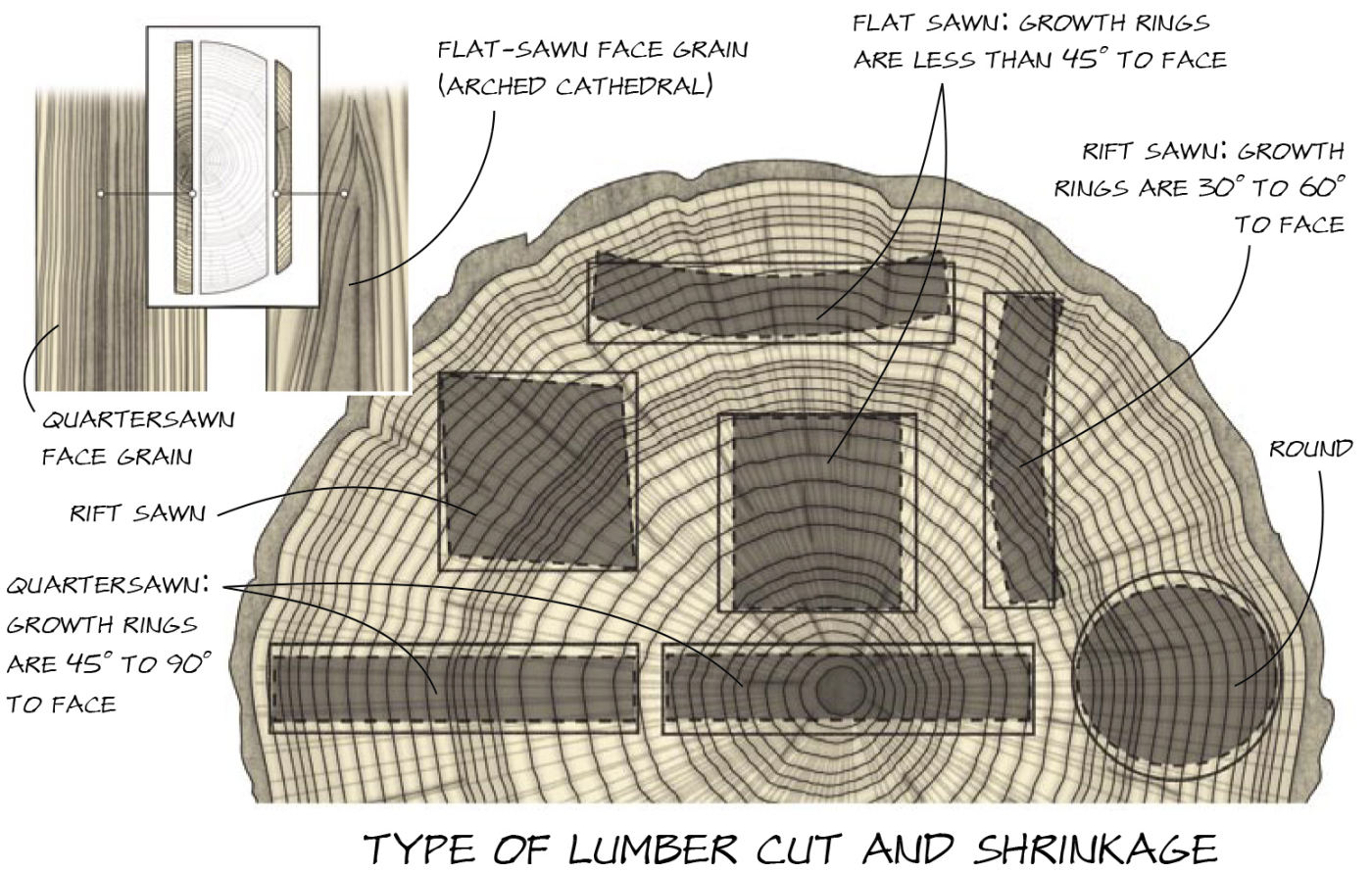
Begin by assessing whether your board is predominantly flatsawn (F/S) or quartersawn (Q/S). Realistically, very few boards are purely one or the other; most fall somewhere in between. The clearest indicator is the end grain pattern: flatsawn wood shows wide, curved growth rings, while quartersawn displays tighter, straighter lines nearly parallel to the edges. Examine the end grain closely (as depicted in the top image of the illustration) to make an educated determination. Once identified, consult a reference chart for common wood species to retrieve the appropriate coefficient value. These charts list separate values for flatsawn and quartersawn orientations, allowing for precise application.
Step 4: Perform the Calculation with Precision
With all three values in hand – the board width in inches, the annual MC change in percentage points, and the species-specific dimensional change coefficient – the computation is elegantly simple. First, multiply the board’s width by the annual MC fluctuation (highest MC minus lowest MC). Then, take that product and multiply it by the coefficient from the chart. The result yields the expected total movement across the width in inches for one year.
Given that boards often mix flatsawn and quartersawn characteristics, it is advisable to calculate both extremes and design your joinery or allowances to accommodate a value somewhere in the middle range. This conservative approach ensures durability regardless of the exact grain orientation distribution.
Practical Example: Consider a workbench top measuring 24 inches wide, constructed primarily from quartersawn yellow pine. In our workshop environment, the moisture content varies annually by 3 percentage points (from 12 percent in humid months to 9 percent in dry periods). Referring to the chart, the coefficients are 0.00176 for quartersawn and 0.00263 for flatsawn orientations.
- Quartersawn calculation: 24 × 3 × 0.00176 = 0.127 inches (approximately 1/8 inch)
- Flatsawn calculation: 24 × 3 × 0.00263 = 0.189 inches (approximately 3/16 inch)
Thus, anticipate movement between 1/8 inch and 3/16 inch and incorporate floating panels, breadboard ends, or other movement-accommodating techniques accordingly. By mastering this method, woodworkers can preemptively address wood movement, leading to projects that remain stable and beautiful for generations.
This systematic approach not only applies to tabletops and wide panels but also informs decisions in door construction, frame-and-panel assemblies, and any application where cross-grain stability is paramount. Regularly monitoring your shop’s MC with a meter refines these predictions over time, building your expertise with each project. Illustrations by Matt Bantly provide visual clarity to these concepts, making the process accessible even for those new to advanced woodworking calculations.